
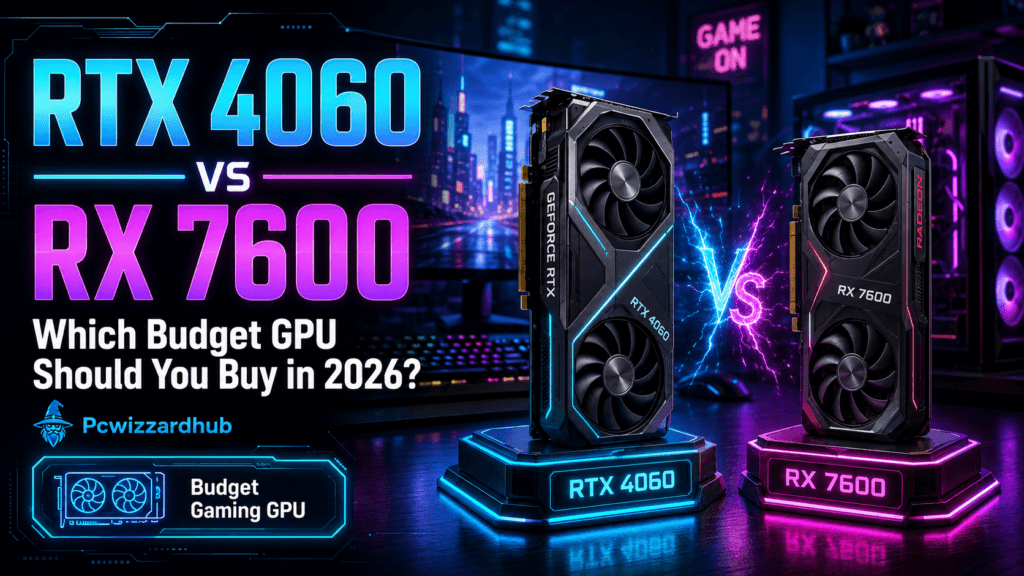
Both the RTX 4060 and RX 7600 sit in the same $270–310 price bracket and target the same buyer: someone building a budget 1080p (or light 1440p) gaming PC. They’re close enough in raw rasterization performance that different review outlets have reached different conclusions about which one is actually faster – so rather than pretend there’s a single clean winner, here’s what’s actually consistent across sources, and where the real differences lie.
🔥 The Quick Answer
- Want ray tracing or DLSS 3 frame generation? Get the RTX 4060 – this is the one area every source agrees on
- Pure rasterized gaming on the tightest budget? The RX 7600 is typically $20–30 cheaper and trades blows in non-RT titles
- Care about power draw / a smaller PSU? RTX 4060 draws roughly 50W less (115W vs 165W)
📦 Both are available directly on Amazon, often with seasonal deals pushing them below sticker price.
📊 Spec Comparison
| Spec | RTX 4060 | RX 7600 |
| Architecture | Ada Lovelace | RDNA 3 |
| VRAM | 8GB GDDR6 | 8GB GDDR6 |
| TDP | 115W | 165W |
| Ray Tracing | 3rd Gen RT Cores | AMD RT Accelerators |
| Upscaling | DLSS 3 (Frame Gen) | FSR 2 / FSR 3 |
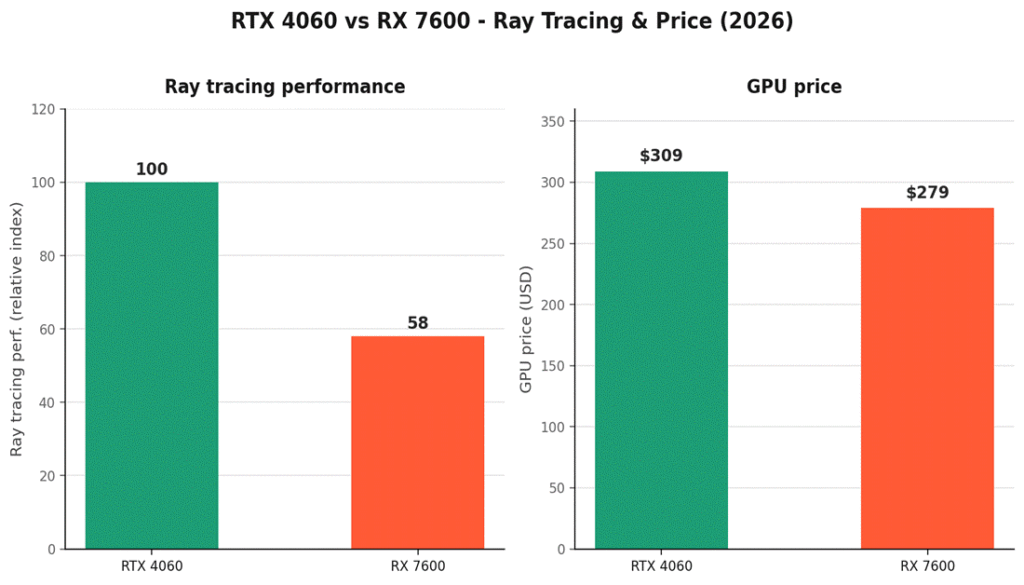
| 🛒 GPU Price | 🛒 ~$309 | 🛒 ~$279 |
Prices fluctuate with Amazon deals — check the live listings for current pricing.
- Both cards ship with 8GB of VRAM, which is the tightest constraint either card will hit in newer titles at higher settings
- Review outlets disagree meaningfully on rasterization-only performance: some show the RTX 4060 ahead by double digits, others show the RX 7600 slightly ahead on average across 100+ games – the gap depends heavily on which titles and settings are tested
🎮 Where the Sources Actually Agree
Cut through the conflicting rasterization numbers, and a few things hold up consistently across every source we checked:
- Ray tracing: the RTX 4060 wins decisively and consistently, with leads ranging from roughly 40% to over 100% depending on the title and resolution tested
- DLSS 3 frame generation gives the RTX 4060 a meaningful edge in supported titles that FSR 2/3 on the RX 7600 doesn’t fully match
- Power efficiency: the RTX 4060’s 115W TDP versus the RX 7600’s 165W is a real, consistent 50W difference – relevant if you’re reusing an older, lower-wattage PSU
- Compute/creative workloads (Blender, Stable Diffusion): the RTX 4060 has a clear advantage thanks to dedicated Tensor cores, if that matters to you beyond gaming
💰 Where It Gets Genuinely Contested
Pure rasterized 1080p gaming performance – no ray tracing, no upscaling – is where outlets disagree. Tom’s Hardware’s testing showed the RTX 4060 ahead by a wide margin; other aggregators averaging 100+ games show the RX 7600 essentially tied or slightly ahead. The honest takeaway: in non-RT titles at 1080p, expect the two cards to trade wins depending on the specific game, and don’t trust any single number you see quoted as the definitive gap.
✅ Who Should Buy the RTX 4060
The 🛒 RTX 4060 is the better buy if any of these apply to you:
- You want to actually use ray tracing, even occasionally
- You’re on an older or lower-wattage PSU and don’t want to upgrade it
- You do any creative or compute work (rendering, AI, video editing) alongside gaming
- You want DLSS 3 frame generation in supported titles
✅ Who Should Buy the RX 7600
The 🛒 RX 7600 is the better buy if any of these apply to you:
- You never enable ray tracing and want the lowest price for rasterized performance
- Every dollar matters and the $20–30 savings is meaningful to your build budget
- You’re pairing it with an AMD CPU and want to lean into Smart Access Memory / FSR ecosystem features
❓ Frequently Asked Questions
Why do different review sites disagree so much on which card is faster?
Different outlets test different game libraries, settings, and CPU pairings, and the RTX 4060 and RX 7600 are close enough in raw rasterization that small methodology differences can flip the result. Treat any single-number “X% faster” claim with skepticism unless you check what games were tested.
Is 8GB of VRAM enough on either card in 2026?
For 1080p gaming at high (not ultra) settings, yes for most current titles. Some newer AAA games at 1440p or with texture packs enabled can push against that ceiling on either card – this is a shared limitation, not an advantage for either side.
Does ray tracing actually matter if I’m on a budget GPU anyway?
It’s a fair question – ray tracing at this performance tier often requires upscaling (DLSS/FSR) to stay playable, which reduces image quality somewhat. If you rarely use it, the RTX 4060’s ray tracing advantage matters less in practice than the numbers suggest.
Which one is better for an AMD Ryzen build?
Either works fine – there’s no meaningful driver or compatibility advantage to pairing AMD GPUs with AMD CPUs beyond Smart Access Memory, which both AMD and Nvidia GPUs can use with a Ryzen CPU on a compatible motherboard.
🔗 Related Reading
- Best Capable Budget GPUs for 1080p Gaming in 2026
- Best still Great Budget GPUs in 2026 – Get More FPS for Less Money
- Best Gaming PC Build Under $1000 in 2026 (AMD Focused)
- Beginner’s Guide to PC Bottlenecks (2026)
⚔️ Final Verdict
If ray tracing, DLSS 3, or lower power draw matter to you at all, the RTX 4060 is the safer, more future-proof pick – and the one area of genuine consensus across every source. If you exclusively play rasterized titles and the $20–30 price gap matters to your budget, the RX 7600 is a perfectly reasonable choice and won’t leave meaningful performance on the table in most games. Neither card is a bad buy at this price point – the honest answer is that the gap between them is smaller than most single-source reviews make it sound.
As an Amazon Associate, PC Wizard Hub earns from qualifying purchases made through the links above.