
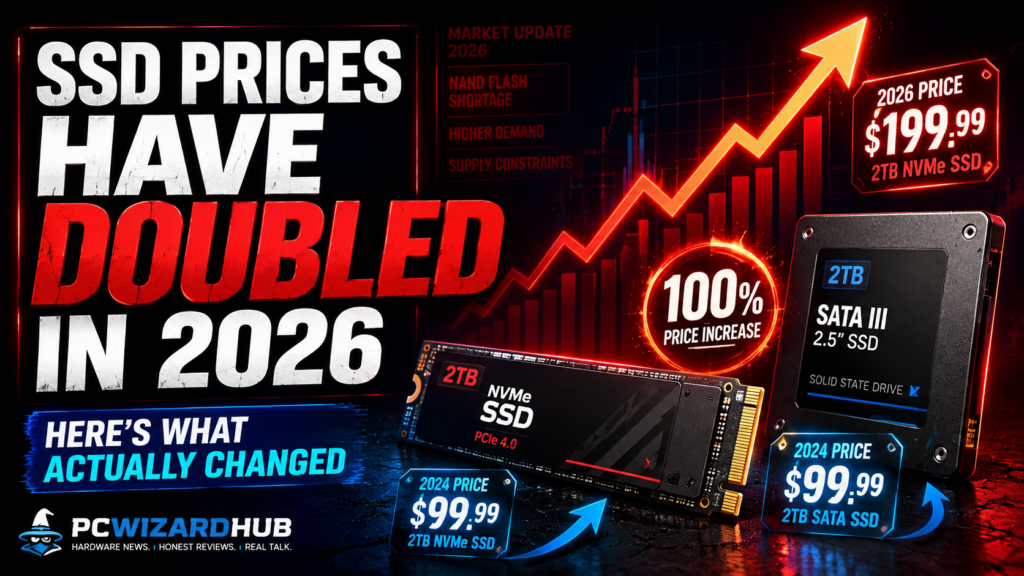
A Samsung 990 Pro 1TB that cost about $90 in October 2025 now sells for around $200. That’s not a typo, and it’s not an isolated case — budget drives from Crucial and Lexar have seen similarly dramatic jumps. If you’ve shopped for storage recently and felt like prices didn’t match your memory of a year ago, you’re right. Here’s what’s actually driving it, and what to do about it.
⚡ Quick Answer
- What happened: 1TB NVMe SSD prices have roughly doubled since October 2025 across nearly every brand and tier, budget and premium alike
- Why: AI data centers are consuming NAND flash at a scale that outpaces supply growth — enterprise SSD orders have soaked up production capacity that used to serve consumer drives
- When it might ease: not soon — forecasts range from late 2026 at the earliest to well into 2027, with new NAND fab capacity not expected until late 2027
- What to do: buy only the capacity you actually need, stick with proven Gen4 drives over cutting-edge Gen5, and don’t wait for a price drop that isn’t coming soon
📊 The Numbers
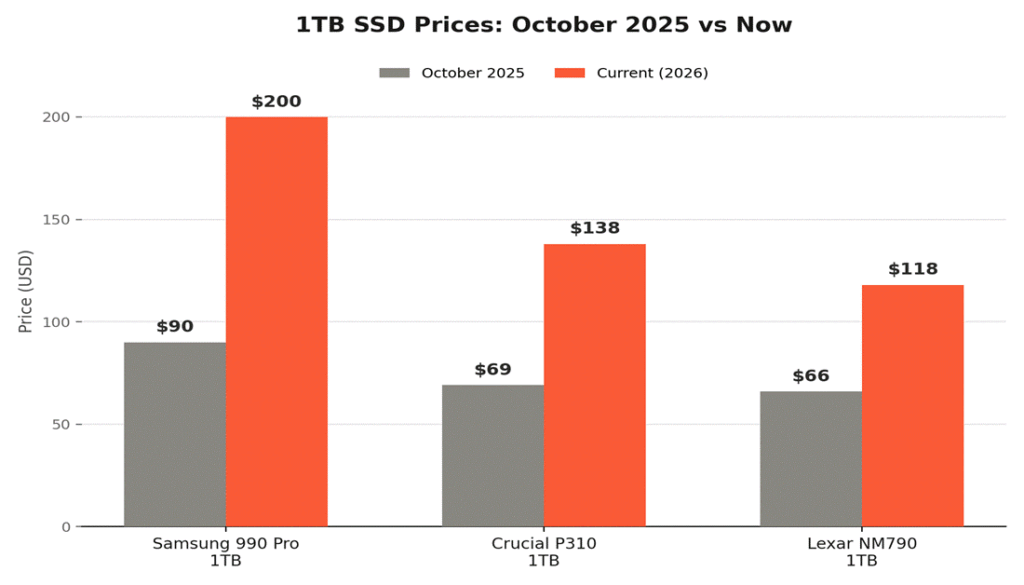
This isn’t limited to premium drives. Budget-tier picks that used to be the easy recommendation for price-conscious builders have seen some of the steepest percentage increases — the Lexar NM790 1TB nearly doubled, and the Crucial P310 1TB followed a similar path.
🧭 Why This Is Happening
The mechanism is structurally similar to the DRAM shortage covered in our RAM pricing breakdown, but with its own specific driver. AI servers require 8 to 10 times more storage than traditional servers to quickly access massive training datasets, and that demand is reportedly growing at 40%+ annually while global NAND flash supply grows only 14–17% a year. NVIDIA’s Inference Context Memory Storage (ICMS) platform alone is projected to represent nearly 3% of global NAND demand in 2026, climbing toward 9% in 2027 — a specific, named driver that didn’t exist at this scale a year ago.
Manufacturers have responded by reallocating capacity: Samsung, SK Hynix, and Micron have all shifted investment toward higher-margin AI and enterprise products, and at least one major consumer SSD brand has reportedly wound down parts of its consumer business entirely to focus on enterprise customers. Controller shortages have compounded the problem — the specialized chips that manage SSDs are themselves competing for limited advanced manufacturing capacity.
🎮 This Hits Console Storage Too
PS5, Xbox, and Switch 2 expansion storage all use the same NAND flash supply chain as PC SSDs, so official and third-party expansion cards are subject to identical cost pressure. There’s no console-specific workaround — if you’re expanding console storage rather than building a PC, the same buying advice below applies.
✅ What to Actually Buy Right Now
- Buy only the capacity you need. Overprovisioning “just in case” compounds the current price premium more than it used to.
- Stick with proven Gen4 over Gen5 unless you specifically need the speed. Gen5 drives command a real premium, and most gaming workloads don’t yet benefit meaningfully from the extra bandwidth.
- Check price history before buying, not just the sticker. camelcamelcamel and PCPartPicker’s price tracker both show whether a “deal” price is actually below recent trend, since baseline prices have shifted enough that old intuitions about what’s a good deal no longer apply.
- Consider 2TB over 1TB if the per-GB math works out. Capacity tiers don’t scale linearly right now — sometimes a 2TB drive is a better value than two 1TB purchases, depending on current sales.
The 🛒 Samsung 990 Pro remains a proven, reliable Gen4 pick despite the price increase, and the
🛒 Crucial P310 is a solid budget-tier alternative that’s still cheaper than premium options even after its own price increase.
💰 Should You Buy Now or Wait?
Every forecast we found points the same direction: waiting for a return to 2025 pricing isn’t a realistic near-term strategy. Jefferies Equity Research projects continued increases through Q4 2026, with new NAND fab capacity not expected until late 2027. If you need storage for a build or upgrade happening soon, the safer financial move is buying at today’s price rather than betting on a drop that most analysts don’t expect anytime soon.
❓ Frequently Asked Questions
Will SSD prices ever go back to where they were?
Eventually, but not soon — the forces driving this (AI infrastructure buildout, factory capacity reallocation toward higher-margin products) are structural shifts measured in years, not a temporary supply hiccup. Most forecasts don’t expect meaningful relief before late 2027.
Is this the same shortage as the RAM/DRAM price surge, or a separate issue?
Related but distinct — DRAM (RAM) and NAND flash (SSD storage) are different memory technologies, but both are experiencing supply pressure from the same underlying cause: AI data centers consuming manufacturing capacity that used to serve consumer products. They’re two fronts of the same broader memory shortage, not the same problem twice.
Are external SSDs and portable drives affected too?
Yes — external SSDs use the same NAND flash as internal drives, so the same cost pressure applies. There’s no meaningful workaround by switching from internal to external storage.
Does this affect hard drives (HDDs) the same way?
No — traditional spinning hard drives use completely different manufacturing technology and aren’t exposed to the NAND flash shortage. If pure storage capacity matters more than speed for a specific use case (bulk archival, for instance), HDDs remain comparatively unaffected by this specific price pressure.
🔗 Related Reading
- Why RAM and SSD Prices Are Skyrocketing in 2026 (And What Budget PC Builders Should Actually Do)
- Best Budget SSDs for Gaming in 2026 (Fast, Cheap & Reliable)
⚔️ Final Verdict
SSD pricing has fundamentally reset in 2026, and treating today’s numbers as an anomaly waiting to correct is the wrong mental model — this is closer to a new baseline than a temporary spike. If you need storage now, buy the capacity you actually need from a proven brand, check price history rather than trusting sticker “deals” at face value, and don’t delay a purchase hoping for a return to 2025 prices that isn’t on the horizon.
Note: pricing in this article reflects market conditions as of early August 2026. SSD pricing has moved quickly and unpredictably this year — verify current prices before making a purchasing decision, and we’ll revisit this article as the market shifts.