
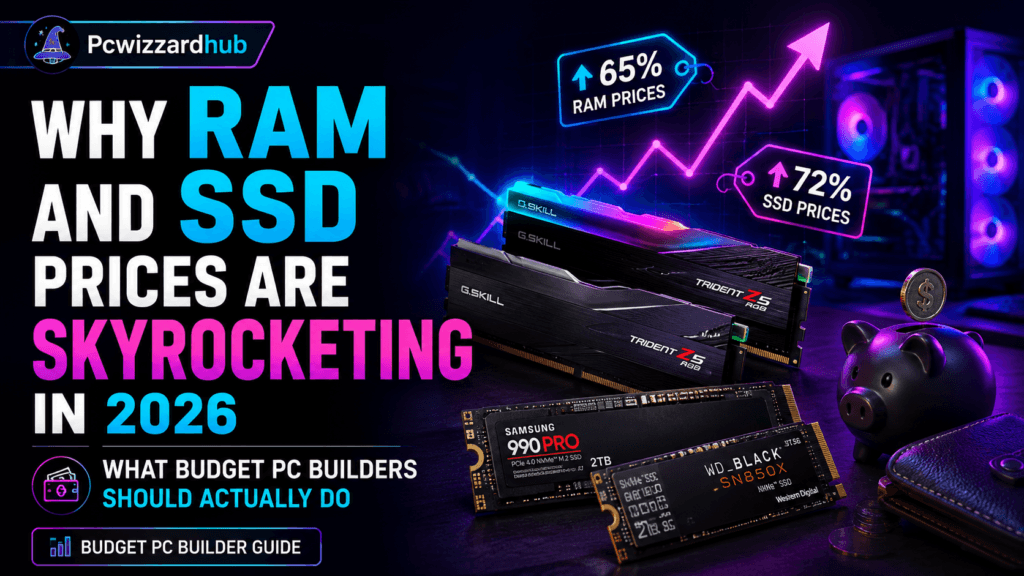
RAM and SSD prices have surged by 90% or more in a single quarter of 2026 — not because of a chip shortage in the traditional sense, but because AI data centers are buying up the memory supply that used to go into ordinary PCs. If you’re planning a build or upgrade right now, this changes the math on almost every part of your budget.
Here’s what’s actually happening, why it’s happening, and what it means for anyone building or upgrading a PC in the months ahead.
⚡ Quick Answer
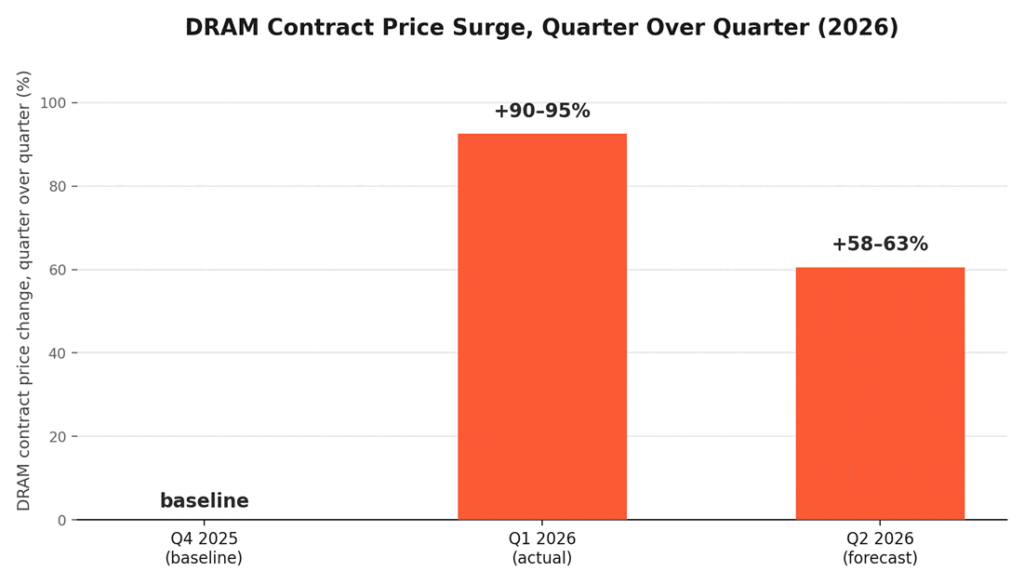
- What’s happening: DRAM (RAM) contract prices rose roughly 90–95% in Q1 2026 alone, with NAND flash (SSD) prices up 55–60% — among the steepest quarterly jumps in memory market history
- Why: AI data centers need enormous amounts of high-bandwidth memory, so manufacturers have shifted factory capacity away from ordinary consumer DDR5 and NAND toward AI-focused chips, shrinking supply for everyday PCs
- When it might ease: Price growth is slowing quarter-over-quarter as consumers hit an affordability ceiling, but multiple analysts expect the shortage itself to persist into at least mid-2027
- What to do: if you need RAM, an SSD, or a full build in the next few months, buying sooner rather than later is the financially safer move — see the strategy section below
📊 How Fast This Happened: A Timeline
| Period | What Happened |
| Late 2025 | Samsung, SK Hynix, and Micron begin shifting fab capacity from consumer DDR5/NAND toward HBM (high-bandwidth memory) for AI accelerators |
| November 2025 | NAND flash contract prices jump 33–55% in a single month as manufacturers like SanDisk raise prices and Transcend briefly suspends new orders |
| Full year 2025 | DRAM prices climb roughly 170% over the year, according to multiple industry trackers |
| Q1 2026 | DRAM contract prices surge 90–95% quarter-over-quarter — far exceeding TrendForce’s already-aggressive 55–60% forecast from January |
| Q2 2026 | Growth decelerates to a still-severe 58–63% QoQ as consumer demand starts softening at the new price levels |
| Q3 2026 (now) | Prices continue climbing on the enterprise/AI side even as consumer pullback begins; PC makers (Dell, HP, Lenovo) raise finished-PC prices 15–20% to offset costs |
🤖 Why AI Is the Actual Cause
This isn’t a repeat of the 2020–2022 shortage, which was mostly pandemic-era logistics and demand chaos. This time, the mechanism is structural: memory manufacturers earn significantly higher margins on HBM (the specialized memory that feeds AI GPU clusters) than on ordinary DDR5 or NAND flash. When Nvidia, Microsoft, Google, and Meta are collectively planning hundreds of billions of dollars in AI infrastructure spending, the fabs follow the money.
The result: every product that ships with standard RAM or flash storage — laptops, desktops, game consoles, handhelds, phones — now competes for a shrinking slice of total memory production. Analysts have described independent memory module makers’ supply as potentially dropping to a fraction of 2026 levels next year if the trend continues.
🎮 Yes, This Is Hitting GPU Prices Too
VRAM on graphics cards is a related but distinct memory market (typically GDDR rather than standard DDR5), but it draws from overlapping fab capacity and raw wafer supply. Current-generation GPU prices have stayed elevated through 2026 in part because of rising VRAM costs, with a lack of the sale discounts buyers would normally expect this deep into a product cycle. If you’re budgeting a build around a specific GPU price point from six months ago, check current pricing before finalizing your build sheet — the numbers likely shifted.
💰 DDR4 vs. DDR5: Which Is the Safer Buy Right Now?
DDR4 has been comparatively more stable than DDR5 through this crisis, since manufacturers are prioritizing DDR5 and HBM production and DDR4 lines are winding down anyway — meaning existing DDR4 inventory hasn’t seen the same demand pressure from AI buyers. If your CPU and motherboard support DDR4 (most AM4 builds, older Intel platforms), that’s currently the more price-stable path.
| Platform | Typical Capacity | Price Stability | |
| 🛒 Crucial 16GB DDR4 3200MHz | AM4 / older Intel | 16GB | More stable — not a primary AI-demand target |
| 🛒 Corsair Vengeance 32GB DDR5 5600MHz | AM5 / current Intel | 32GB (2x16GB) | Directly exposed to the current price surge |
Prices fluctuate with Amazon deals and the ongoing memory market volatility — check the live listings, since these numbers can move week to week right now.
- If you’re already committed to an AM5 or current-Intel build, DDR5 prices aren’t going to become a reason to switch platforms — but budget for the current, not last quarter’s, price
- If you’re still deciding between AM4 and AM5 for a new budget build, DDR4’s price stability is a genuine point in AM4’s favor right now, on top of its already-lower platform cost
🧭 Should You Buy Now or Wait?
Every credible analyst tracking this situation agrees on one thing: waiting for prices to drop back to 2025 levels is not a near-term strategy. Deceleration in the rate of increase does not mean prices are falling — it means they’re rising more slowly. Multiple industry voices, including memory market analysts cited by Yahoo Finance and TrendForce’s own quarterly outlooks, expect the shortage to persist into at least mid-2027.
That reframes the actual decision. It’s not “buy now vs. wait for a sale” — it’s “buy now vs. very likely pay more later.” If you have a build or upgrade planned for this year regardless, the financially safer move is to lock in RAM, SSD, and GPU pricing sooner rather than later.
✅ Practical Strategies for Budget Builders Right Now
- Buy memory and storage in the same order as your CPU/motherboard, not after. If you’re staging a build over several paychecks, prioritize RAM and SSD purchases early — these are the components moving fastest.
- Don’t overbuy capacity “just in case.” Buying 64GB when you need 32GB compounds the current price premium. Match capacity to your actual use case.
- Consider DDR4 platforms if you’re still choosing. An AM4 build with a capable Ryzen CPU is currently a more price-stable path than an equivalent AM5 build, on top of AM4’s already-lower baseline cost.
- Use price-tracking tools before buying. Camelcamelcamel (Amazon price history) and PCPartPicker’s price tracker both show whether a listed price is actually a deal or a recent price hike — essential right now, when list prices are moving week to week.
- Re-check GPU budgets against current prices. If your build plan is based on GPU pricing from early 2026 or before, assume it’s stale and verify before finalizing your parts list.
❓ Frequently Asked Questions
Will RAM prices go back down in 2026?
Unlikely this year. The rate of increase is slowing, but slowing growth still means prices are going up, just less steeply. Most analyst forecasts point to the memory shortage continuing into at least mid-2027 before any meaningful relief.
Is it worth delaying a PC build until prices drop?
For most people, no — there’s no credible forecast showing a price drop in the near term, and PC makers have already raised finished-system prices 15–20% to match. If you need a PC now, waiting mainly risks paying more later, not less.
Does this affect laptop prices too, or just desktop components?
Both. Laptops, gaming consoles, and handhelds all ship with the same DRAM and NAND flash affected by this shortage, and manufacturers across the board have raised prices or reduced memory configurations (a practice sometimes called “spec shrinkflation”) to manage costs.
Is DDR4 a smart long-term choice, or just a short-term workaround?
It’s a reasonable short-to-medium-term choice if you’re building a budget system today, since DDR4 platforms are cheaper and more price-stable right now. It’s not a long-term platform decision, though — DDR4 production is winding down industry-wide, so it’s not the choice for a system you expect to upgrade five years from now.
🔗 Related Reading
- Best DDR4 RAM for Gaming & Budget Builds in 2026
- Best Budget SSDs for Gaming in 2026 (Fast, Cheap & Reliable)
- Best Budget AM5 CPU and Motherboard Combos in 2026
- Best AM4 Budget Motherboards in 2026
- Best Capable Budget GPUs for 1080p Gaming in 2026
📚 What This Means for Your Next Build
If you’re following one of our budget build guides, treat the listed prices as a snapshot, not a guarantee — memory and GPU pricing are moving faster right now than at almost any point in the last several years. The build logic (AM4 for tightest budgets, AM5 for longevity, matching GPU tier to your actual resolution/refresh needs) hasn’t changed. What has changed is that the RAM and SSD line items in your budget deserve a fresh price check before you commit, even if you researched your build just a few weeks ago.
Note: memory and storage pricing in this article reflects market conditions as of early August 2026. This is a fast-moving situation — check current prices before making purchasing decisions, and we’ll revisit this article as the market shifts.