
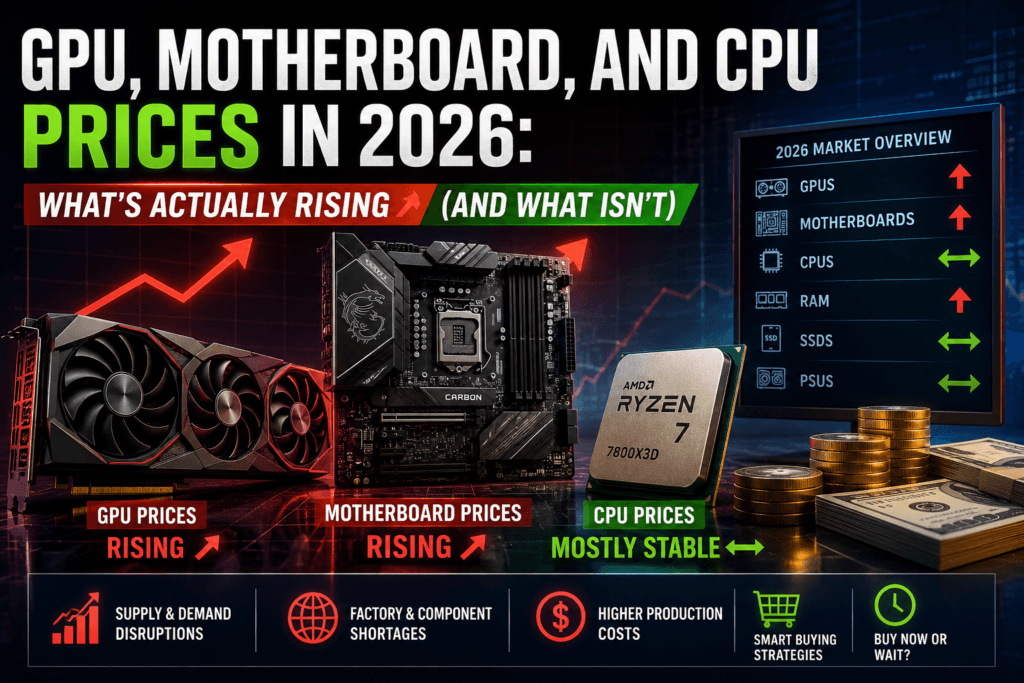
If you’re planning a high-end PC build right now, the honest answer is: it depends heavily on which component you mean. GPU prices are climbing for the third time this year. Motherboard makers are preparing price hikes as steep as 50%. And yet flagship CPUs are sitting at some of their lowest prices ever. This isn’t one uniform price crisis — it’s three very different stories happening at once.
Here’s what’s actually happening in each category, backed by real numbers, and what it means if you’re building or upgrading a high-end system this year.
⚡ Quick Answer
- GPUs: Nvidia has reportedly raised GPU-kit prices 20–30% — its third increase in 2026 — driven by rising GDDR7 memory and TSMC wafer costs. AMD Radeon prices are also set to rise roughly 10% in August
- Motherboards: ASUS, Gigabyte, and MSI are reportedly preparing price increases of at least 50% in Q3 2026 as PCB, copper, and component costs surge
- CPUs: the exception — flagship chips like the Ryzen 9 9950X3D are currently near record-low prices thanks to retailer promotions, since CPU dies themselves aren’t as exposed to the memory/PCB cost spikes
- Bottom line: if you’re building high-end, buy your GPU and motherboard sooner rather than later — but there’s no similar urgency on the CPU itself
📊 Where Prices Actually Stand Right Now
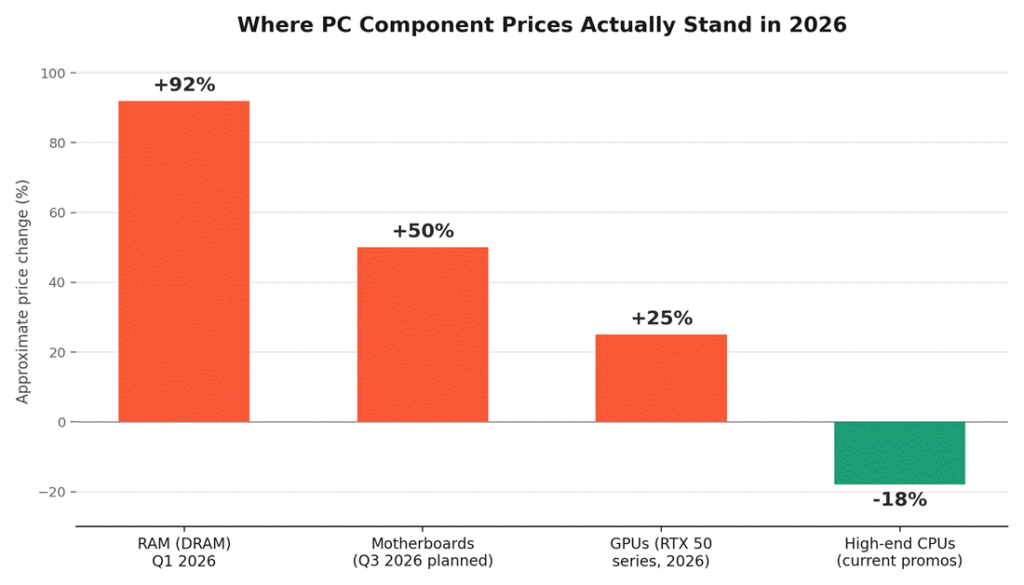
Figures are approximate, sourced from multiple industry reports as of early August 2026 — see sections below for detail and sourcing on each category.
🎮 GPUs: The Third Price Hike of 2026
Nvidia has reportedly raised the price of GPU kits — the bundled GPU-plus-memory packages it sells to board partners like ASUS, Gigabyte, and MSI — by 20 to 30%, according to Taiwan’s Economic Daily News. This would mark the third such increase this year, following earlier hikes in January and May. The reported cause is rising GDDR7 memory costs combined with TSMC raising prices across its advanced chipmaking process nodes, including older nodes previously considered stable.
This isn’t limited to flagship cards — reports indicate the increase could extend across the broader RTX 50 lineup, not just high-end models like the RTX 5090. AMD isn’t exempt either: Radeon GPU prices are reportedly set to rise around 10% in August, tied to the same underlying memory cost pressure.
The price movement is already visible at retail. The 🛒 RTX 5070, which launched at a $549 MSRP, is now commonly selling in the $599–620 range on Amazon — and that’s before the newest round of reported increases fully lands at retail.
🧭 Motherboards: A 50% Jump Is on the Table
Multiple reports — originating from Taiwanese industry outlet Board Channels and corroborated by several hardware publications — indicate ASUS, Gigabyte, and MSI are preparing motherboard price increases of at least 50% starting in Q3 2026. The driver is rising PCB (printed circuit board), copper, and electronic-component costs, compounded by weaker overall PC upgrade demand giving manufacturers less room to absorb costs by selling higher volume.
The dollar impact scales with price: a $200 board could land north of $300, and premium boards with beefier VRMs and more connectivity could see even larger absolute increases. Skyrocketing DDR5 prices have reportedly already cut into motherboard sales volume, creating a difficult spiral where manufacturers face both higher costs and softer demand at the same time.
As a real reference point, the 🛒 ASUS ROG Strix X870E-E Gaming WiFi — a well-regarded high-end AM5 board — currently sells in the $417–474 range. If the reported 50% increase materializes broadly, a board in that tier could realistically approach $600–700.
✅ CPUs: The Surprising Exception
Here’s the part that doesn’t fit the doom narrative: flagship CPU prices haven’t followed the same trajectory. AMD’s Ryzen 9 9950X3D, a 16-core, 32-thread flagship with 128MB of 3D V-Cache, launched at a $699 MSRP and has recently hit record-low prices around $569–600 at Amazon and Newegg — an 18–20% discount, not a hike.
Why the difference? CPU dies themselves aren’t directly exposed to the DRAM/NAND cost spike the way GPUs (VRAM) and motherboards (PCB/component costs) are. CPU pricing is driven more by manufacturing yield, competitive positioning against the other vendor, and retailer promotion cycles — none of which are currently under the same upward pressure.
If you’re building a high-end system, the 🛒 Ryzen 9 9950X3D at its current promotional pricing is arguably one of the better values in the entire build right now — a rare bright spot.
💰 What This Means for a High-End Build Right Now
Total build cost math has shifted meaningfully in 2026, but not evenly:
- GPU and motherboard: buying sooner rather than later is the safer financial move — both categories have credible, sourced reports of further price increases still working their way to retail
- CPU: no similar urgency — current promotional pricing on flagship chips is genuinely good, and there’s no strong signal it’s about to get worse
- RAM: still under separate, even steeper pressure — see our dedicated breakdown of the DRAM/SSD price surge for the full picture
If you’re staging a high-end build over several paychecks, this suggests a specific order of operations: lock in your GPU and motherboard first, and don’t stress about waiting on the CPU — it’s currently one of the least time-sensitive parts of the build.
❓ Frequently Asked Questions
Should I buy a GPU now, or wait for the price hike to fully hit?
If you need one this year, buying sooner is the safer move — the reported 20–30% increase is still working its way from GPU-kit pricing (what Nvidia charges board partners) into final retail prices, and existing inventory may still reflect older, lower pricing.
Why are motherboard prices rising so much more than GPU prices, percentage-wise?
Motherboards are hit by a compounding problem: rising raw material costs (PCB, copper, components) plus weaker unit sales volume from consumers delaying builds due to high RAM prices. GPUs have strong underlying demand even at higher prices, which softens the percentage impact somewhat.
Is now a bad time to build a high-end PC overall?
It’s a mixed picture, not a uniformly bad time. CPU pricing is currently favorable, while GPU and motherboard pricing is trending upward. If you need to build now regardless, prioritizing the GPU and motherboard purchases first is the more cost-effective sequencing.
Will these price increases affect budget parts too, or just high-end?
Reports suggest the GPU price increase could extend across the full RTX 50 lineup, not just flagships, and motherboard cost pressure affects the whole market since it’s driven by raw material costs rather than a premium-tier-specific factor. Budget parts aren’t immune, even if the article focus here is high-end.
🔗 Related Reading
- Why RAM and SSD Prices Are Skyrocketing in 2026 (And What Budget PC Builders Should Actually Do)
- Best Budget AM5 CPU and Motherboard Combos in 2026
- Ryzen 7 5700X3D vs 7800X3D: Which Budget Gaming CPU Should You Buy in 2026?
- RTX 4060 vs RX 7600: Which Budget GPU Should You Buy in 2026?
- Best Gaming PC Build Under $1000 in 2026 (AMD Focused)
📚 The Bottom Line
2026’s PC hardware pricing story isn’t one crisis — it’s three separate ones layered together, and they don’t all point the same direction. GPUs and motherboards are both trending upward for well-documented, sourced reasons tied to memory and raw material costs. CPUs are, for now, bucking that trend entirely. If you’re planning a high-end build, that asymmetry is worth building into your purchase order, not just your budget.
Note: pricing and reported increases in this article reflect market conditions as of early August 2026. This is a fast-moving situation across all three categories — verify current prices before finalizing a build, and we’ll revisit this article as the market shifts.